Custom character plushProject inquiries · Personal follow-up by email

From artwork to a physical starting point

A clear process, explained in plain language.

You bring the character knowledge. We organize the decisions that turn a creative idea into a project a plush maker can evaluate.

The working path

Seven steps, grouped into three decisions.

The process stays intentionally human. Unusual characters get room to be understood before cost and production constraints shape the plan.

01

Understand

Begin with a free character review

We begin with the identity of the character, not a factory specification.

01

Share your character

Send clear artwork or a private link, plus a short description of what you hope to make. A finished character sheet is helpful, but it is not required for the first review.

You provide: artwork, a goal and any must-keep features.

02

Project review

We review silhouette, expression, clothing, accessories, intended size and quantity, then identify the details that need clarification.

You receive: a first human reply within 1 business day, with further questions where needed.

03

Focused clarification

If the direction makes sense, we ask focused questions about the character. Your intended quantity and budget are welcome now, so the production approach can be discussed before you decide on a paid sample. Any early estimate depends on its design assumptions.

You receive: a short, project-specific question list.
02

Prototype

Turn decisions into a sample

The paid sample gives both sides something physical and specific to evaluate.

04

Sample scope and quote

We outline the proposed size, main materials, included features, sample fee, revision boundary and estimated sampling window.

You decide: whether the proposed sample scope is right for the character.

05

Paid sampling

Sampling starts only after the scope and fee are agreed. The first physical sample reveals proportion, feel and construction choices that a drawing cannot fully answer.

You receive: a physical development sample and a clear basis for focused refinement.

06

Review and refinement

Feedback is organized around the agreed priorities. New outfits, major proportion changes or added features may require a separate assessment.

You receive: a focused revision path with clear boundaries.

03

Decide

Plan what comes next

Discuss the production approach early; confirm the batch specification and quotation once the sample direction is approved.

07

Production discussion

If the sample direction is approved, quantity, packaging, quality expectations, production timing and shipping can be assessed with far fewer unknowns.

You decide: stop at the sample, prepare a small run or plan a larger release.

Your sample review checklist

Approve the details, not just a flattering photo.

Use these seven checkpoints to compare a sample with the agreed brief. The photos, measurements, videos and physical delivery included in your review are confirmed in the sample proposal.

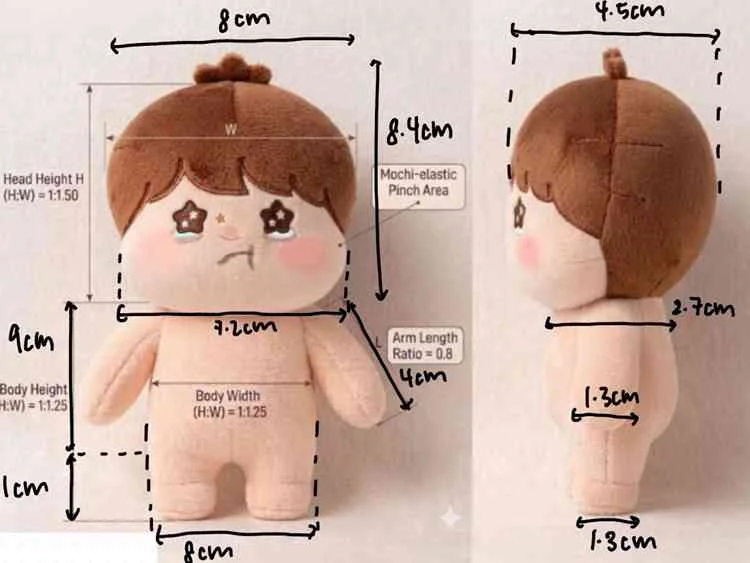
Front and side views of a reference plush with annotated measuring points
Measurement reference · not your sample specification

A useful review starts with comparable evidence.

A front view cannot show the back construction. A close-up cannot establish the full size. Ask for the views that answer your character’s important questions.

The reference image illustrates measuring points; its numbers are not a standard size, tolerance or promise for your project.

Understand the material choices ↗
01

Character & proportions

Compare the silhouette, head-to-body ratio, pose and placement of ears, wings or tail.

Useful evidence Front, side and back views against the agreed artwork.

02

Size & measurement

Check the agreed key dimensions. State whether ears, hair, wings or loops count in each measurement.

Useful evidence A ruler photo with the agreed measuring points; tolerances confirmed for the project.

03

Fabric & color

Review texture, pile direction, panel colors and the way different materials meet.

Useful evidence Material references and consistent-light photos; use a physical swatch where color or feel is critical.

04

Face & surface details

Check expression, eye spacing, embroidery position, print clarity and important markings.

Useful evidence An unobstructed front view plus close-ups at the intended product size.

05

Seams, filling & pose

Look for uneven seams, exposed filling, distorted areas or a pose that differs from the brief.

Useful evidence Close-ups and a handling video if included in the scope. Photos alone cannot confirm softness.

06

Accessories & functions

Review whether each outfit, loop, prop or other part is fixed or removable, as agreed.

Useful evidence Attachment details and any agreed function demonstration; specialist testing is a separate requirement.

07

Labels & packaging

Check label artwork, tag placement and the agreed packaging arrangement when included.

Useful evidence The correct artwork version and packing reference; do not assume retail packaging is included.

From feedback to a clear decision

Keep one sample version and one feedback list.

Agree the review package before paid work. Specific feedback helps separate a correction to the brief from a new design request.

  1. Consistent viewsFront, side and back photos of the same sample version, with key features visible.
  2. Details & dimensionsClose-ups and ruler photos for the priorities agreed in the sample scope. Add video or physical delivery when agreed.
  3. One feedback listNumber each point: what you see, what you want changed, and whether it is essential or optional.
  4. A recorded decisionKeep the sample version, agreed changes and written approval together before discussing a production specification.

What to prepare

You can begin before everything is perfect.

A clear character and a useful conversation matter more than knowing factory terminology.

What you can send

Enough for a first review

  • One clear image, sketch, sheet or private artwork link
  • A sentence about what you hope to make
  • An approximate size, quantity or “not sure yet”
  • The expression, outfit, wings, tail or prop that cannot lose its identity

What we help decide

The technical questions can come next

ScaleFabricEmbroideryConstructionPackagingTiming

You do not need exact fabric names, embroidery specifications, packaging dies or production language in the first form.

First step

Start with the character. We can work out the specifications together.

Start an inquiry