Curly head surround
White and pale-pink curly-pile candidates
Frame the smooth cheek volume without burying the face edge.
Trial before choosing
Curl behavior, backing stretch, seam thickness and escaped fibers after assembly.
Design & making notes / 05
Curly spirit series
Join several textures without burying the face or building bulky accessory roots.
Free initial artwork review · first human reply within 1 business day
Before the construction
Compare the unchanged reference with the proposed drawing. Structure is useful only when it protects the character you recognize.
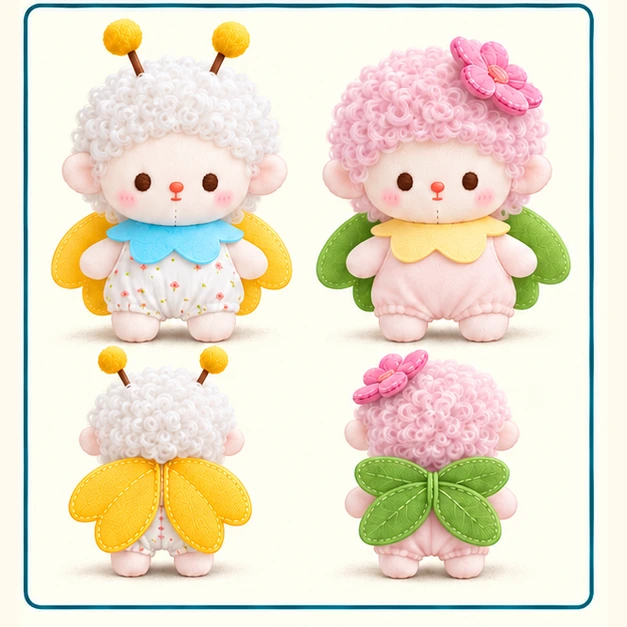
Views are cropped and scaled independently for reading, not measured overlays or an accuracy rating. These drawings communicate a development route; sampling still decides the final likeness.
01 / Look inside the idea
Four product-specific illustrations. Open a single drawing for a closer look, or compare the complete board.
Open all four drawings ↗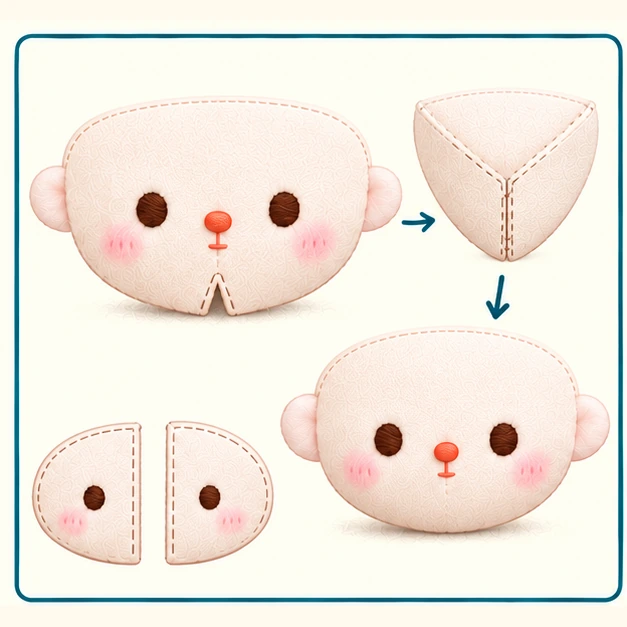
A single face with a lower V-shaped dart becomes a cupped face once the dart is closed; the small paired halves are a separate alternate.
S-F is continuous across the eyes and forehead. The short lower-edge take-up tapers below the mouth. The folded wrong-side inset shows the shaping seam; the finished chin is closed. The smaller two-half sketch is not a later step in this route.
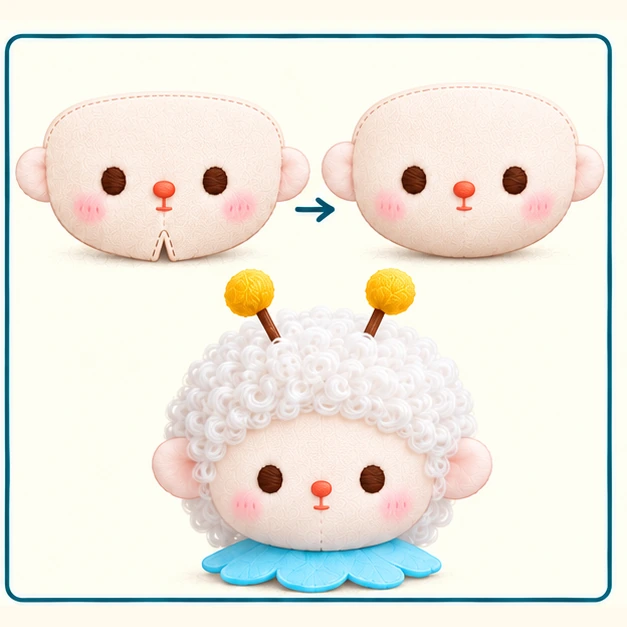
Face details are prepared first, the local lower dart closes next, and only then is the shaped face joined to the curly head surround.
Read left to right, then down. The accessible face operation does not move behind the closed head. The face perimeter still needs matching seam-line landmarks and the shell retains planned turning access; the drawings are not ready-to-cut geometry.
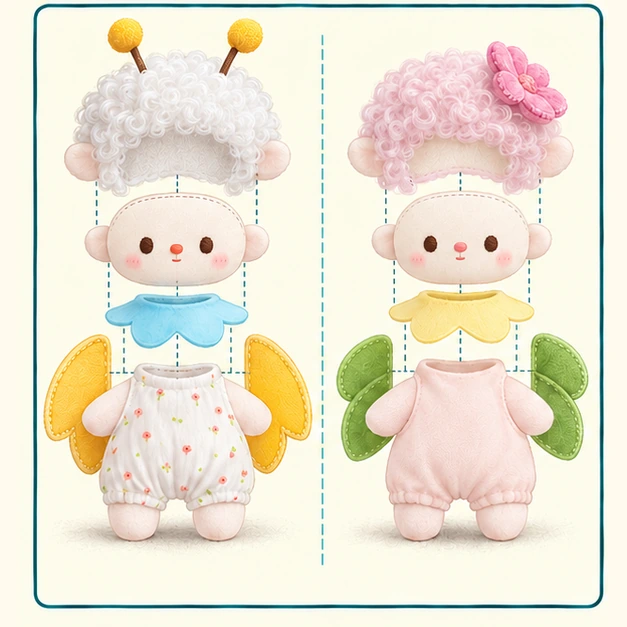
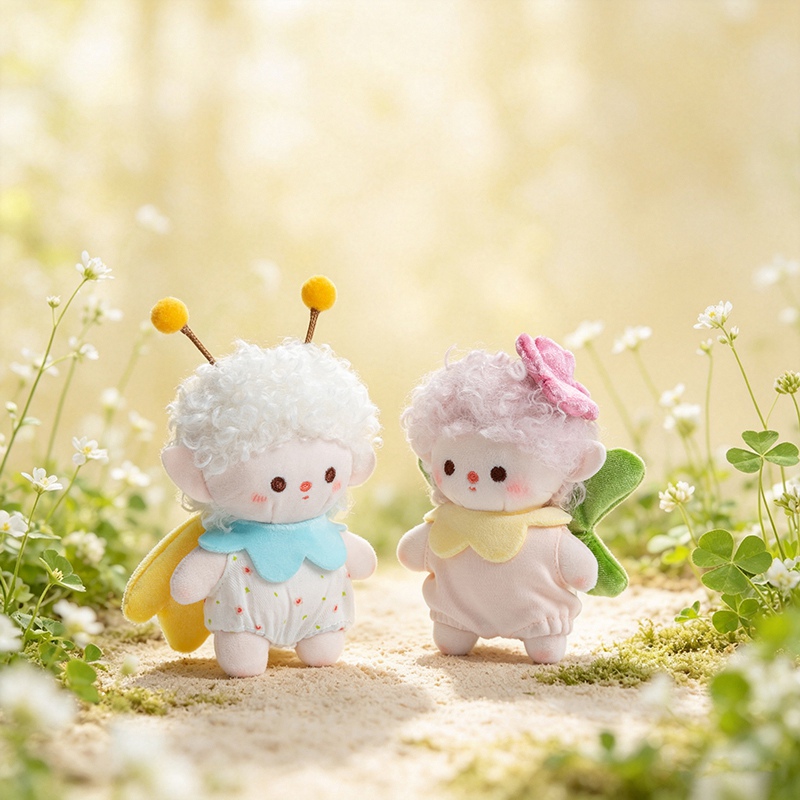
The white character’s antennae and yellow back detail remain separate from the pink character’s flower and green back detail.
Prepare the collar and back components in separate accessible operations. Other yellow variants do not provide interchangeable parts for these two.
Compare cheeks, curls, ears, collar height and each variant’s accessory count without blending the two.
Inspect both identities separately. Any short lower-face line is a proposed shaping clue only, not an asserted original seam; no full forehead join is required. Compare curl boundary, collars and each back attachment after filling.
AI-assisted concept illustrations, paired with product-specific design notes. Not production photographs, measured drawings or ready-to-cut patterns.
Solid outlines show conceptual cut edges; inset dashed lines indicate proposed stitching. A turning gap is a short unsewn section, not a virtual cutaway. Back views and internal details are development proposals, not unseen reference photographs. Diagrams explain relationships rather than executable geometry.
02 / Material map
These are candidate directions, not an inferred bill of materials or a stock promise.
Curly head surround
Frame the smooth cheek volume without burying the face edge.
Curl behavior, backing stretch, seam thickness and escaped fibers after assembly.
Shaped face
Develop a single face panel with a short lower-edge shaping dart while keeping the upper face continuous.
Dart depth and point, cheek volume, closed chin contour and feature positions after shaping; compare a two-panel alternate only if needed.
Collars & outfits
Keep each variant’s petal layers and clothing readable without a bulky neck junction.
Layer order, edge thickness, collar position and interaction with the body.
Variant accessories
Keep the white and pink character identities distinct throughout assembly.
Turning, attachment access and shape retention without assuming metal or rigid internals.
03 / Construction choices
04 / Proposed making sequence
The practical sequence proposed for this design, with a checkpoint at every stage. This is not a record of past factory work.
Record the small mark beneath the nose without assuming a full center join. Map a single face with a short lower dart and keep each variant’s accessories separate.
Review: The continuous upper face is the main proposal; curved halves are an alternate only.
Embroider eyes, cheeks and nose/mouth on the accessible flat panel. Fold the dart right sides together, sew from the lower edge to its tapered tip, then open the face into a cupped form with a closed chin.
Review: The dart stops below the mouth. It leaves no open V notch and no full-face decorative center seam.
Align the face perimeter and curl-shell landmarks, place ears and the corresponding head accessory roots, and preserve turning access.
Review: The smooth face keeps its full visible edge; only the white character receives the antenna pair.
Complete the thin petal collar and body/outfit components separately; secure the corresponding wing or leaf roots during accessible rear-body assembly.
Review: Variant colors do not migrate and all roots do not collapse into one unexplained neck knot.
Seat the prepared collar in the planned neck sequence, join head and body, then turn and fill through the reserved access.
Review: The collar does not roll over the face and back decorations do not force an unintended head angle.
Compare face shaping, curl boundary, ears, head accessories, collar and back details in separate front/side/rear records.
Review: A hybrid character cannot stand in for the two distinct variant checks.
05 / Sample review
Appearance and function checkpoints for this concept. They do not establish product safety compliance or replace any required testing.
Flat feature work, accessible dart sewing and the face-surround join follow one complete route; the finished chin has no open V.
The photographed line, selected single-panel lower dart and optional two-half face are explicitly distinguished.
White has two antennae; pink has a flower, with their own collar, outfit and back-detail colors.
Face boundary, collar and back roots can each be examined without an unexplained pile-up at the neck.
No exact size, cutting pattern, material composition, filling weight or test result is reconstructed from this photograph.
General methods inform the proposal. These links do not establish the pictured product’s manufacturing history or any Kinhatch certification.
Terminology, darts, curved seams, fabric direction and appliqué principles; not a pattern for any pictured character.
Examples of shaping, seam-line alignment, captured attachments and rear turning openings. Its specific shapes and dimensions are not transferred.
Examples of fringe appliqué on an accessible face panel before three-dimensional head assembly. Its dart count and body pattern are not copied.
Fabric-supplier guidance on pile, stretch, handling and seam control; product-specific fabric settings require trials on the chosen material.
A different animal showing paired ear assembly and an unfilled neck-ring join with a separate turning opening; a construction analogy, not a matching product record.
Your character comes next
Which is most important in your series: rounded cheeks, curly texture or the full outfit palette, and which accessories must stay unique to each character?
Send your artwork for a free initial review. First human reply within 1 business day; physical sampling is a separate paid step.
Explore another construction challenge