Body shell
Lavender long-pile fabric candidates
Keep the fuzzy outline while allowing the face and side depth to be controlled separately.
Trial before choosing
Nap, stretch in both directions, shedding and recovery after grooming.
Design & making notes / 01
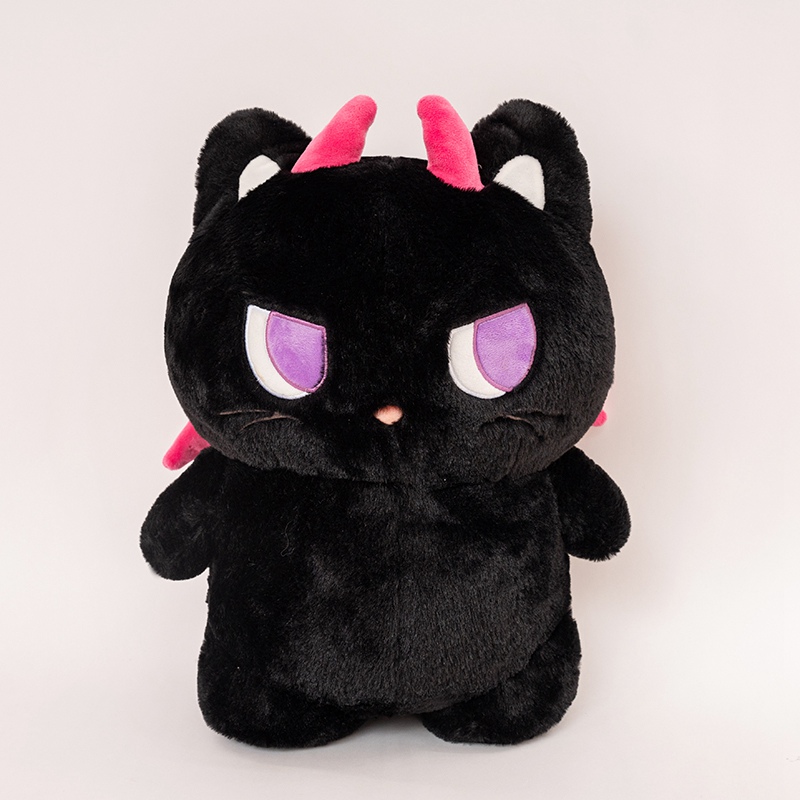
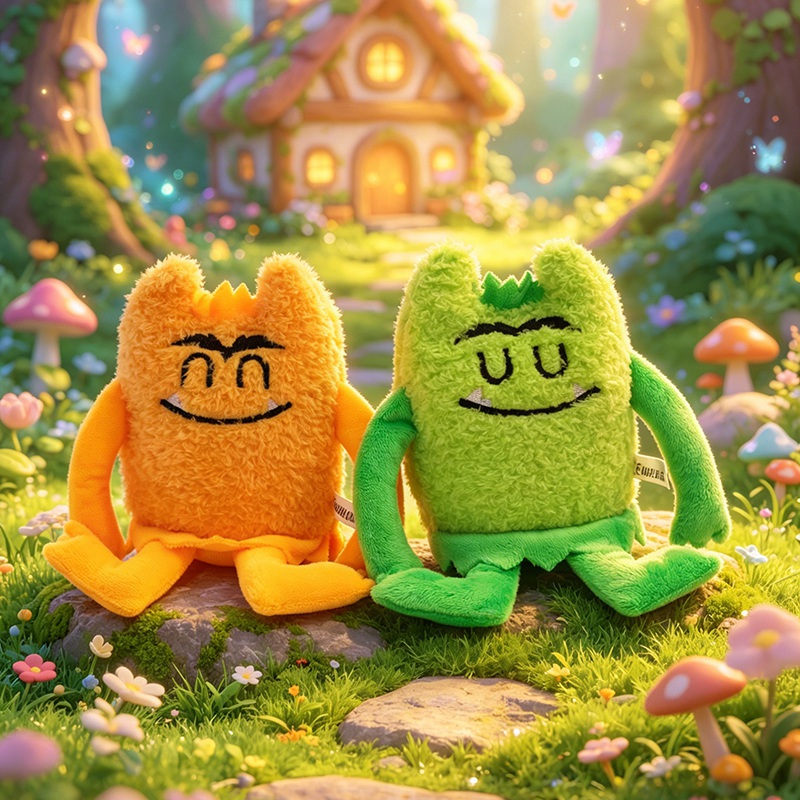
Lavender fur creature
Keep the cloud-like outline without letting the fur swallow the smile.
Free initial artwork review · first human reply within 1 business day
Before the construction
Compare the unchanged reference with the proposed drawing. Structure is useful only when it protects the character you recognize.
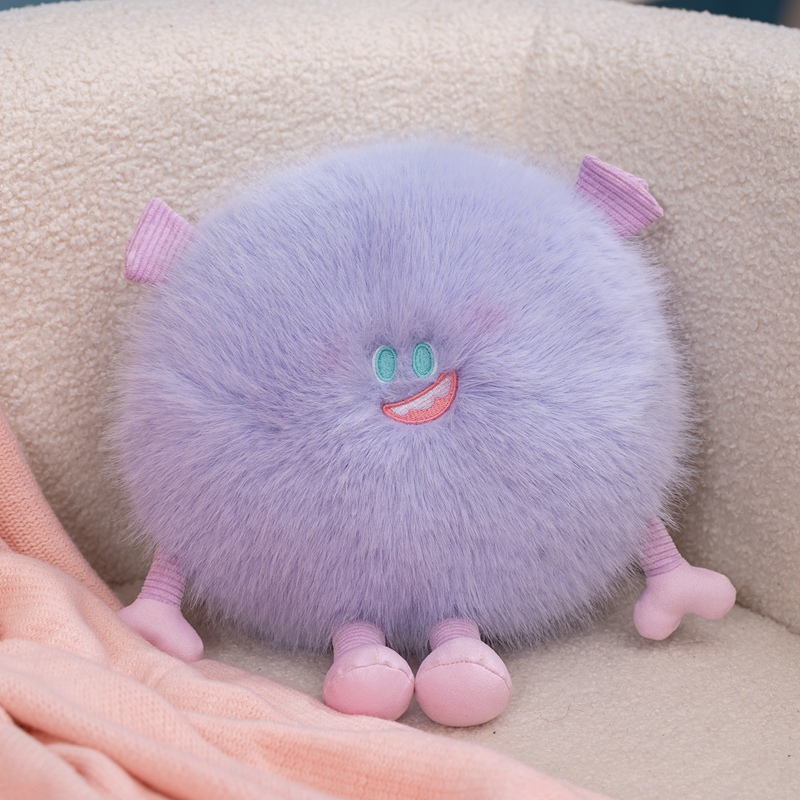
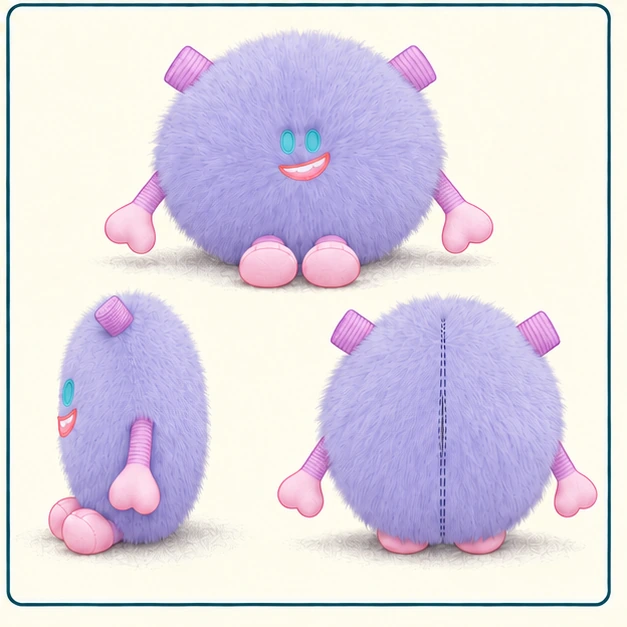
Views are cropped and scaled independently for reading, not measured overlays or an accuracy rating. These drawings communicate a development route; sampling still decides the final likeness.
01 / Look inside the idea
Four product-specific illustrations. Open a single drawing for a closer look, or compare the complete board.
Open all four drawings ↗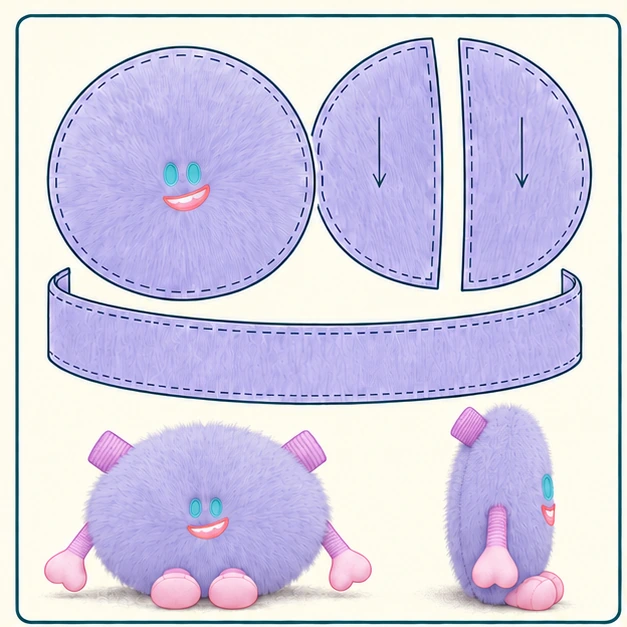
The front, split rear and depth band lead to one shallow cushion profile, shown from the front and true side.
P-F joins one edge of P-G; the joined rear panels meet the other. The band seam closes its circumference. Smooth dome and shallow depth remain consistent in the finished views; a spherical shell would require a different pattern. Landmarks and lengths still need a full-size pattern trial.
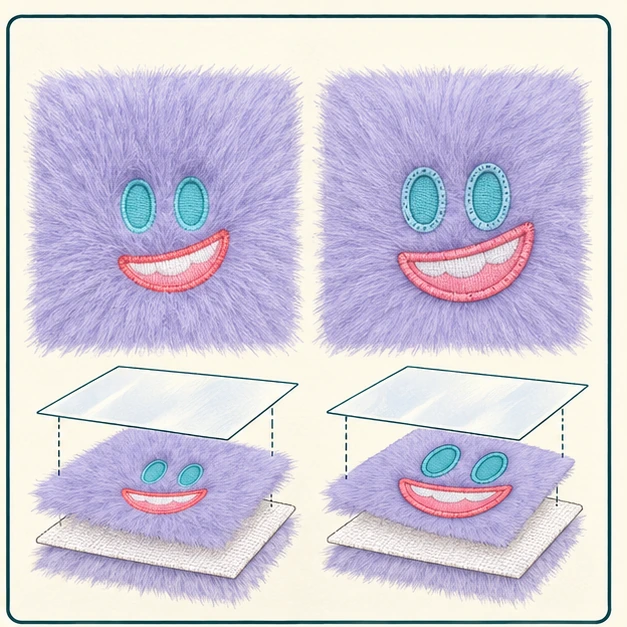
Keep the same eye and smile shapes while comparing supported direct stitching with a thin matching appliqué.
The backing support and optional topper serve different purposes. Compare softness and readability after grooming before choosing the route.
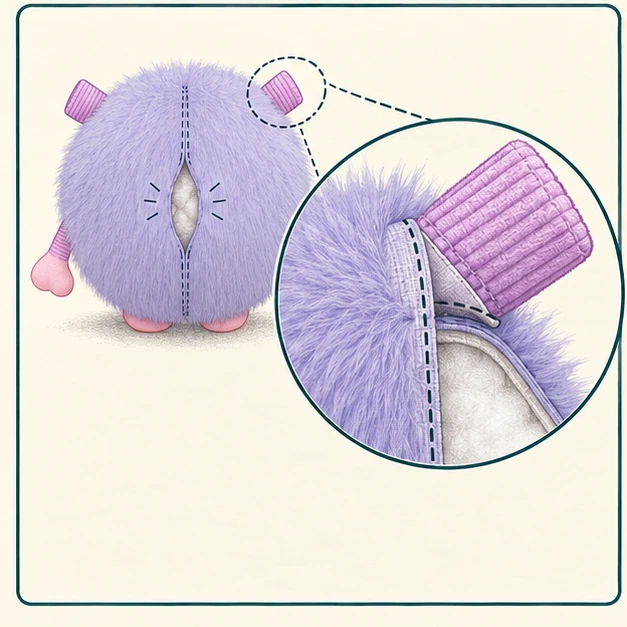
A root detail explains permanent seam capture; a rear detail shows where turning and filling remain accessible.
An imaginary cutaway is only a viewing aid. It must not replace the actual rear opening or suggest that the entire finished front opens for filling.
Front, narrow side and closed rear views all follow the cushion route; the small original expression stays within the long-pile outline.
The closed rear in this finished-state view is different from the reserved opening in drawing 03. Compare face scale, paired roots and depth together; these are not measured elevations of the photographed product.
AI-assisted concept illustrations, paired with product-specific design notes. Not production photographs, measured drawings or ready-to-cut patterns.
Solid outlines show conceptual cut edges; inset dashed lines indicate proposed stitching. A turning gap is a short unsewn section, not a virtual cutaway. Back views and internal details are development proposals, not unseen reference photographs. Diagrams explain relationships rather than executable geometry.
02 / Material map
These are candidate directions, not an inferred bill of materials or a stock promise.
Body shell
Keep the fuzzy outline while allowing the face and side depth to be controlled separately.
Nap, stretch in both directions, shedding and recovery after grooming.
Horns & arm sleeves
Retain the contrast between the narrow parts and the long-pile body.
Turning access, rib direction, root bulk and stretch after filling.
Hands & feet
Define small hand curves and foot contours without excessive seam bulk.
Left/right orientation, clean curves and recovery after handling.
Face support
Keep the small turquoise-and-coral face readable without making the center rigid.
Actual-size face trials after brushing; select topper and pile treatment on the chosen fabric.
03 / Construction choices
04 / Proposed making sequence
The practical sequence proposed for this design, with a checkpoint at every stage. This is not a record of past factory work.
Map the small face and attachment roots, then develop the illustrated shallow cushion profile. Keep a ball-shell redesign as a separate option.
Review: Front likeness and side-depth intent are separate decisions; the main route is no longer left undecided.
Compare the turquoise eyes and coral-and-white smile on the selected pile using the direct and appliqué routes.
Review: The face remains legible without holding the fibers aside.
Mark nap on the backing; make and turn the horns, arm sleeves, hands and feet before placing their roots.
Review: Mirrored pairs, accessible narrow parts and consistent cutting direction.
Join the split rear around a short center-back turning gap; match its perimeter and the circular front to opposite edges of the depth band by sewing-line landmarks. Capture the planned roots at their designated joins.
Review: Match sewing-line lengths and quarter points in pattern development; conceptual strip lengths are not cutting dimensions.
Add filling in small areas and compare the front and side together rather than stretching the face to achieve depth.
Review: No unintended face bulge or deep dimples around the roots.
Close the rear opening, release trapped pile and record front, side and rear views under consistent light.
Review: Expression, paired attachment heights and the chosen side profile remain coherent.
05 / Sample review
Appearance and function checkpoints for this concept. They do not establish product safety compliance or replace any required testing.
Both eyes and the original smile remain recognizable after brushing and light compression.
Seam-line landmarks match and the selected depth is achieved without forcing the front out of shape.
Two horns, two arms, pink hands and two feet keep their identity and orientation throughout.
Check the attachment seams and backing, then release trapped pile rather than hiding defects under fur.
No exact size, cutting pattern, material composition, filling weight or test result is reconstructed from this photograph.
General methods inform the proposal. These links do not establish the pictured product’s manufacturing history or any Kinhatch certification.
Terminology, darts, curved seams, fabric direction and appliqué principles; not a pattern for any pictured character.
Examples of shaping, seam-line alignment, captured attachments and rear turning openings. Its specific shapes and dimensions are not transferred.
Fabric-supplier guidance on pile, stretch, handling and seam control; product-specific fabric settings require trials on the chosen material.
Stabilizer, accessible embroidery, pile management and topper options. An inconsistent unit conversion in the source is excluded from these proposals.
Backing-first cutting, pile direction, trapped-fiber release and heat caution. Garment seam allowances are not adopted as plush specifications.
Your character comes next
Would your character work best as a rounded cushion or a separately developed ball shape, and how small should its expression remain within the fur?
Send your artwork for a free initial review. First human reply within 1 business day; physical sampling is a separate paid step.
Explore another construction challenge