Face & limbs
Smooth pale short-pile candidates
Support facial detail while allowing the shaped face to remain soft.
Trial before choosing
Embroidery support, color consistency, stretch and deformation after filling.
Design & making notes / 04
Outfit character doll
Keep the character recognizable when the face curves, the hair joins and the clothes go on.
Free initial artwork review · first human reply within 1 business day
Before the construction
Compare the unchanged reference with the proposed drawing. Structure is useful only when it protects the character you recognize.
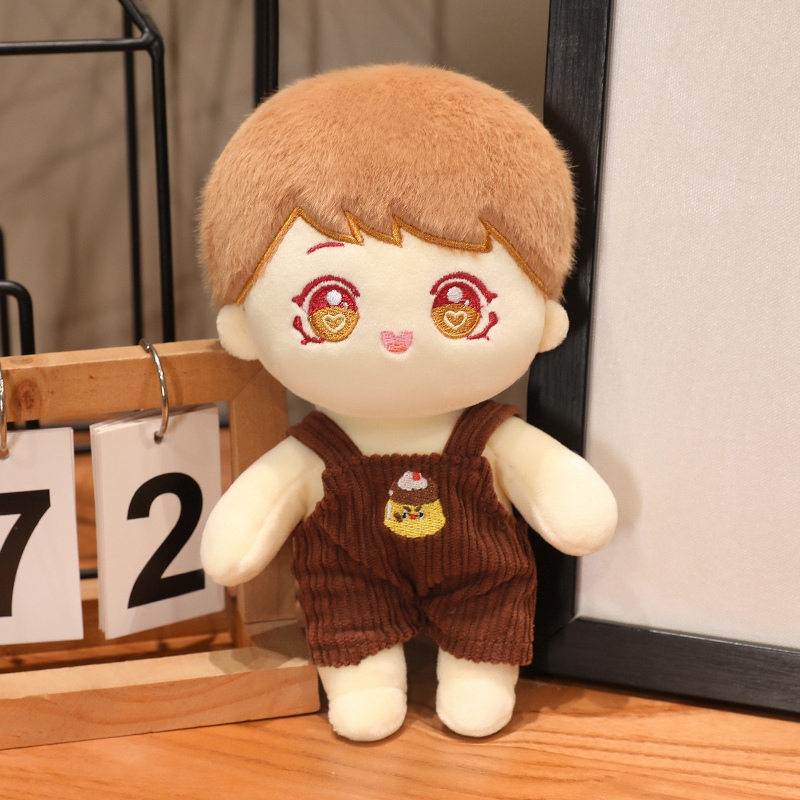
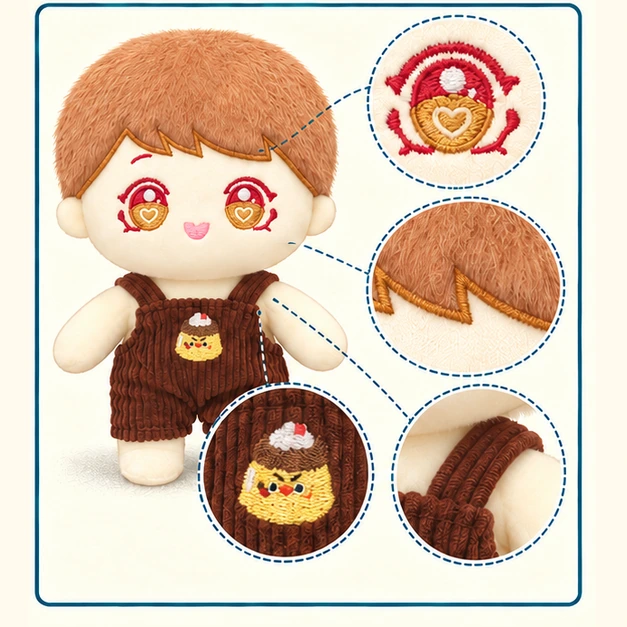
Views are cropped and scaled independently for reading, not measured overlays or an accuracy rating. These drawings communicate a development route; sampling still decides the final likeness.
01 / Look inside the idea
Four product-specific illustrations. Open a single drawing for a closer look, or compare the complete board.
Open all four drawings ↗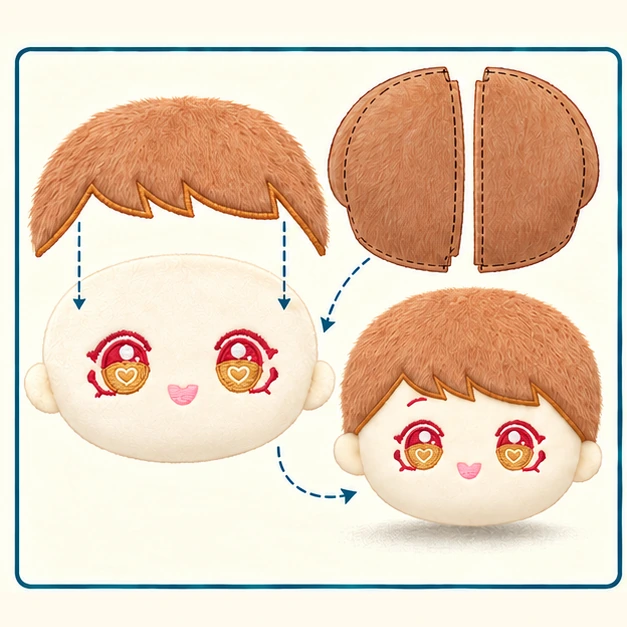
Separate the pale face, front fringe appliqué and brown rear head/hair panels in one coherent layer map.
The original fringe edge is the visual reference. Pink-haired variants do not supply unseen brown-hair panels or closure details.
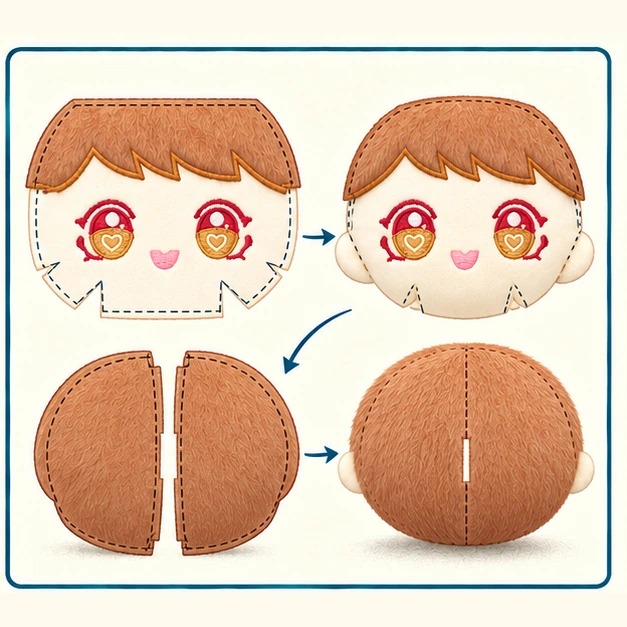
Face work and the fringe come before progressive dart shaping, rear-head joining and the short reserved back opening.
Keep red-and-gold eye details clear of shaping lines. Intermediate sketches show shaping in progress, not a fixed dart count or executable geometry. Finish the chosen shaping seams before shell assembly; define the neck and rear access together.
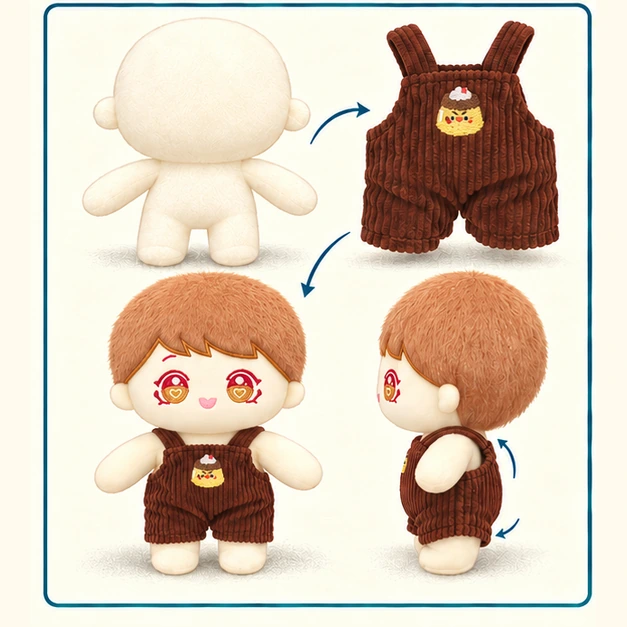
Trial the separated overalls components on one stable body, then plan their fixed attachment; removable clothing remains a separate option.
Separate garment drawings explain fit and operation access, not the original outfit function. In this main fixed route, settle motif placement and attachment access before closure. A removable version needs a separate opening and physical dressing trial.
Inspect eye highlights, fringe points, chest motif, strap clearance and body-to-outfit proportions together.
Review the exact photographed chest motif as its own artwork; a newly invented decorative emblem is not an acceptable likeness shortcut.
AI-assisted concept illustrations, paired with product-specific design notes. Not production photographs, measured drawings or ready-to-cut patterns.
Solid outlines show conceptual cut edges; inset dashed lines indicate proposed stitching. A turning gap is a short unsewn section, not a virtual cutaway. Back views and internal details are development proposals, not unseen reference photographs. Diagrams explain relationships rather than executable geometry.
02 / Material map
These are candidate directions, not an inferred bill of materials or a stock promise.
Face & limbs
Support facial detail while allowing the shaped face to remain soft.
Embroidery support, color consistency, stretch and deformation after filling.
Front fringe & rear hair
Develop one clear hairline rather than duplicating a complete cap over an already finished fringe.
Nap, edge thickness, pointed fringe shapes and clearance above the eyes.
Overalls
Develop the visible clothing texture separately from the body shell.
Actual weave, bending, seam bulk and access for the agreed dressing function.
Eyes & chest motif
Keep eye highlights and the original chest identity legible at different scales.
Registration, small details and stiffness before the garment or head becomes difficult to reach.
03 / Construction choices
04 / Proposed making sequence
The practical sequence proposed for this design, with a checkpoint at every stage. This is not a record of past factory work.
Map eye spacing against face width, eye level against the fringe and the bib-to-body proportions. Use fixed styling as the main proposal; treat changing clothes as a separate request.
Review: These are reference relationships for trial comparison, not invented measured specifications.
Trial the eyes and brown fringe appliqué on the flat face, ordering overlapping details before finalizing their edges.
Review: Allow for the selected three-dimensional shaping: compare eye spacing, fringe clearance and cheek outline again on the filled head, not only on the flat artwork.
Close the selected shaping darts, join the rear hair/head panels and retain the planned neck opening.
Review: The shaping lines create volume; they are not copied decorative marks or a borrowed dart count.
Prepare limbs and body, join the unfilled head/body neck openings, then use the planned rear opening to turn and tune the fill.
Review: The joining edges remain reachable before filling and the head faces the intended direction.
Prepare the chest motif while the garment is accessible, fit the bib, straps and trouser sections to the settled body, and plan fixed attachment points before final garment closure.
Review: Fixed styling is the main route. A removable alternate needs a separately demonstrated dressing opening and ease.
Compare hairline, eyes, chest motif and clothed proportions; inspect body shape separately and demonstrate dressing only if requested.
Review: Tight clothes do not conceal or distort an unresolved body shape.
05 / Sample review
Appearance and function checkpoints for this concept. They do not establish product safety compliance or replace any required testing.
Key eye highlights and chest shapes are not replaced with generic decorative artwork.
One front fringe route meets the rear hair/head panels without duplicate caps or unreachable seams.
Straps and openings do not pull the neck, compress the torso or disguise an unresolved body shape.
Fixed or removable status matches the chosen brief and, when applicable, a physical dressing trial.
No exact size, cutting pattern, material composition, filling weight or test result is reconstructed from this photograph.
General methods inform the proposal. These links do not establish the pictured product’s manufacturing history or any Kinhatch certification.
Terminology, darts, curved seams, fabric direction and appliqué principles; not a pattern for any pictured character.
Examples of fringe appliqué on an accessible face panel before three-dimensional head assembly. Its dart count and body pattern are not copied.
Fabric-supplier guidance on pile, stretch, handling and seam control; product-specific fabric settings require trials on the chosen material.
How fabric stretch and filling interact with a doll’s head shape; filling choices must be compared on the proposed shell.
Your character comes next
Should your character have a fixed outfit or be changeable, and which eye and fringe details must never be simplified?
Send your artwork for a free initial review. First human reply within 1 business day; physical sampling is a separate paid step.
Explore another construction challenge